Central Acropolis residential district
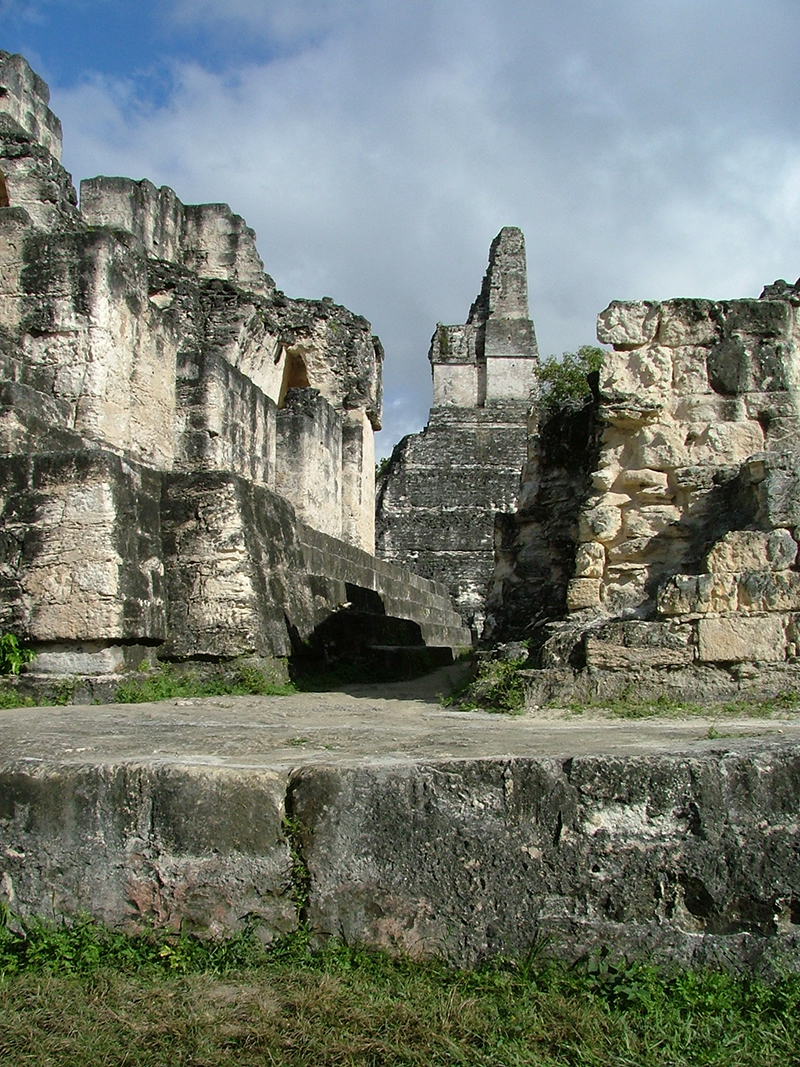
Structure 5D-61 [to the left], now partially cleared and consolidated, faces east. It is a single-story palace containing three rooms, each with its own exterior doorway. A series of platform extensions at the rear of the building led to the eventual construction of 5D-62 [on the left], the two stories of which also face east. Although the second story seems to have been incorporated in the original construction, it underwent some modification by the addition of the north room and the benches in the main room. The exterior stairway on the south end is integrated as a unit with the walls of the first story.
William R. Coe, Tikal: A Handbook of the Ancient Maya Ruins, p.58
home : : : map : : : inner-map
High altitude photos were done by Jeff
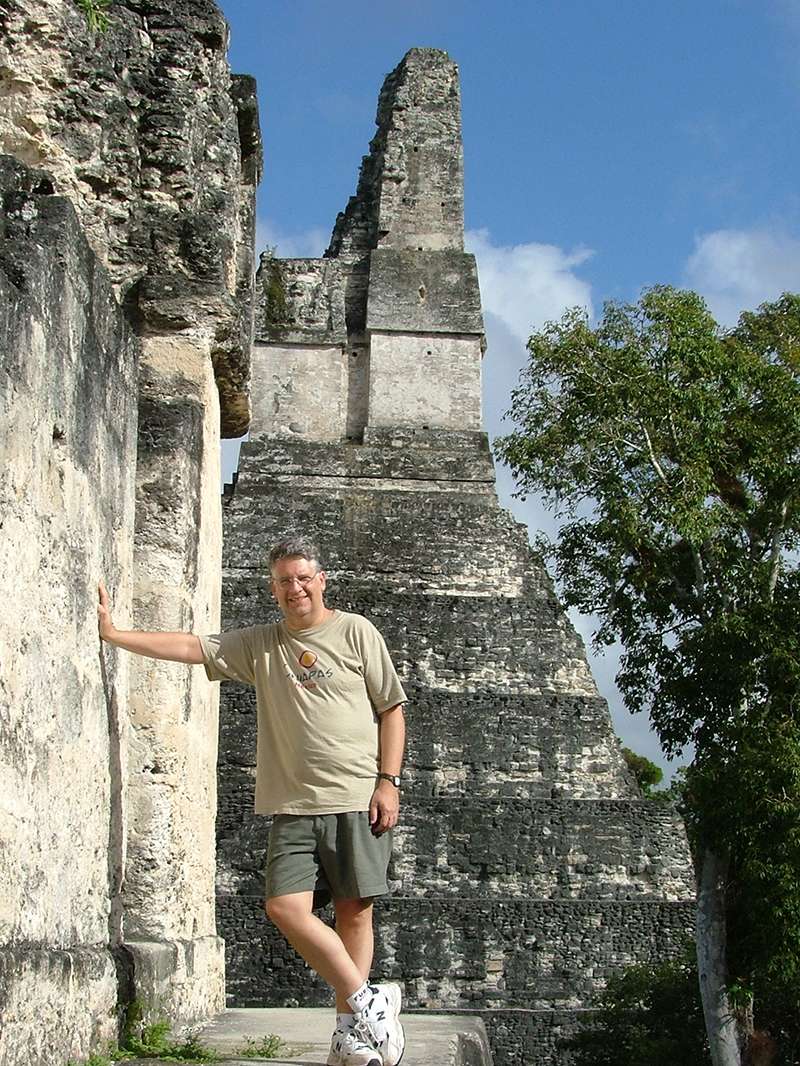
This is our friend Jeff Purcell, fearless climber and photographer extraordinaire. Jeff has taken some of the best high altitude photos on this website. Thanks, Jeff!
home : : : map : : : inner-map
The magnificent Temple I
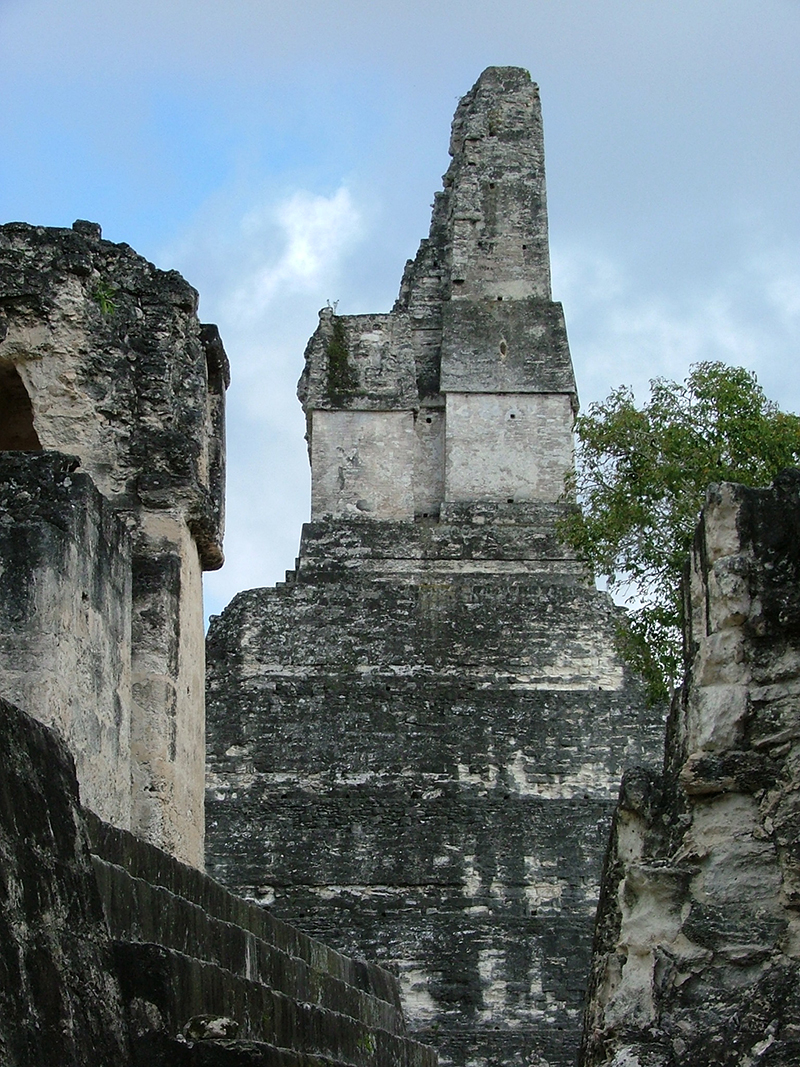
Temple I was built by Jasaw Chan K'awiil I who ruled from AD 682 to 734 and who achieved a decisive victory over Calakmul on 5 August 695, This battle initiated Tikal's rebirth as a major military power after a long hiatus.
home : : : map : : : inner-map
Building Hierarchy by height
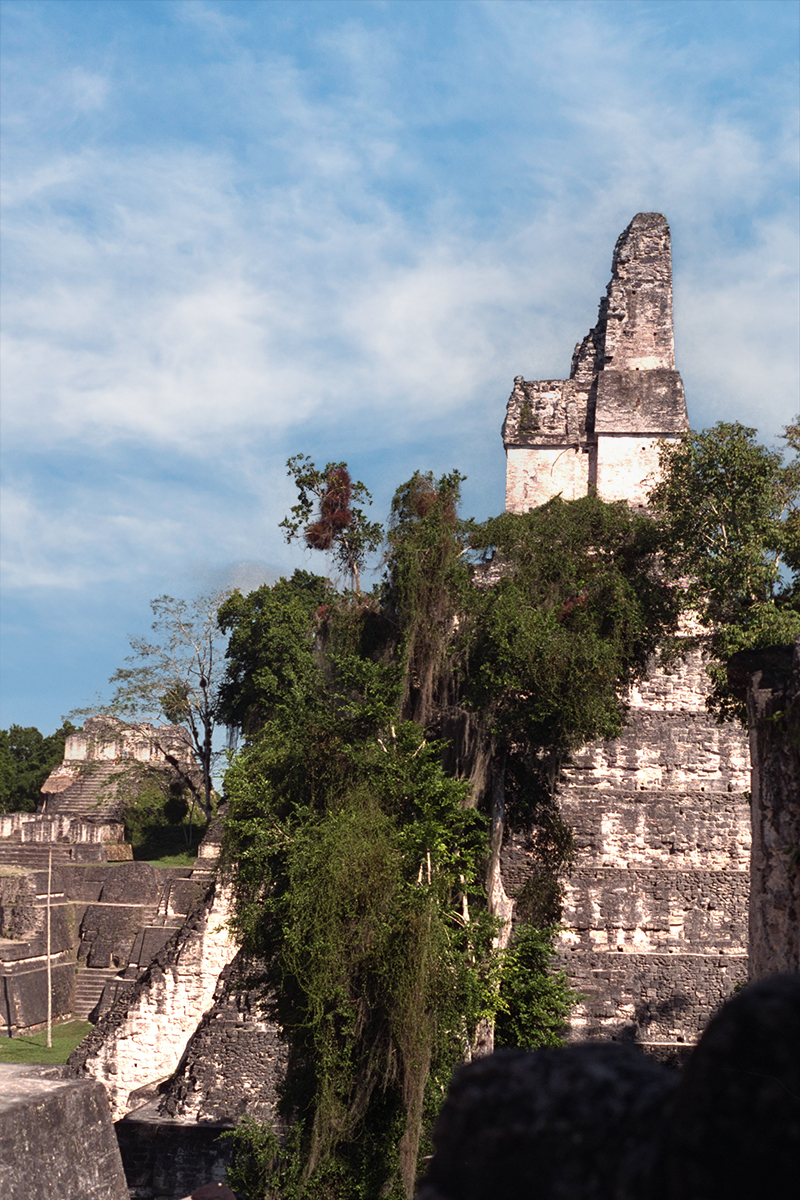
The alleged palaces and temples merge into one another by continuous gradations. Probably a cardinal objective of the Maya architect was to achieve differentiation by height, in many levels marking the rank of the vague functions to which the edifices were dedicated. At the same time he was always extremely sensitive to the spaces engendered between rand among edifices, seeking to achieve large and rhythmically ordered open volumes. Such open volumes with storied changes of level are the most striking formal achievements of Maya architectural history."
George Kubler, The Art and Architecture of Ancient America, p.207
home : : : map : : : inner-map
North Acropolis from Central Acropolis
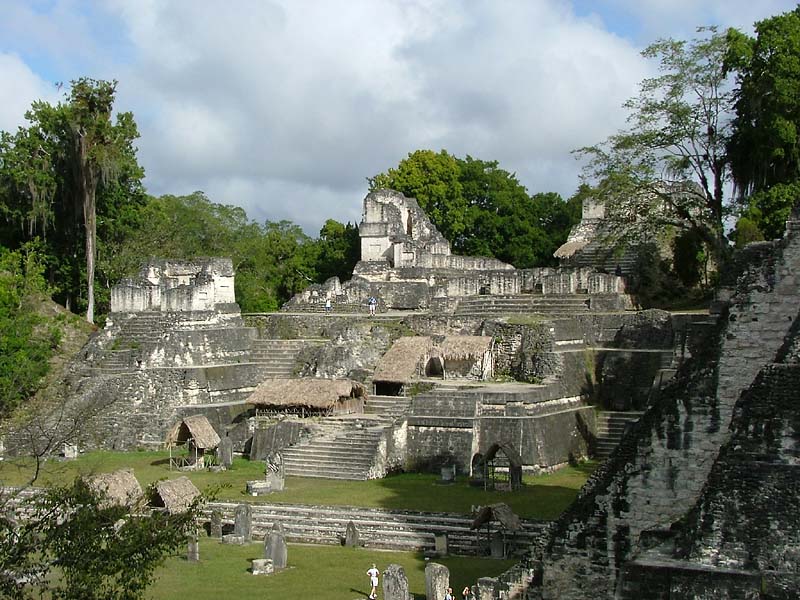
The central platform with the three thatched roof coverings is all that remains of the huge 5D-33-1st , which was demolished by archaeologists to reveal these thatch-covered remnants of earlier constructions hidden within it.
)
At one time, Temple 5D-33-1st rivaled Temple I in height and scale, and formed what has been termed a Triadic Complex with Temples I and II. This grouping of pyramids, where a dominant central pyramid is flanked by two companion pyramids facing each other at right angles with the central pyramid, has been a feature of Maya architecture since its beginnings in the Late Pre-Classic El Mirador basin, and whose ancient significance is still being debated.