East Court & Throne Room Complex
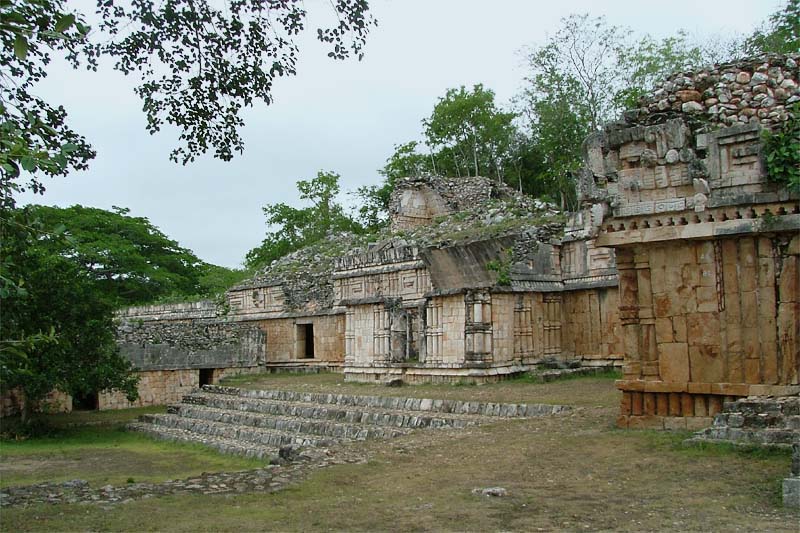
The out-jutting room with lighter colored stone is the antichamber to the earliest throne room of the palace complex, rooms 22–25 of the palace.
Map of Construction Phases
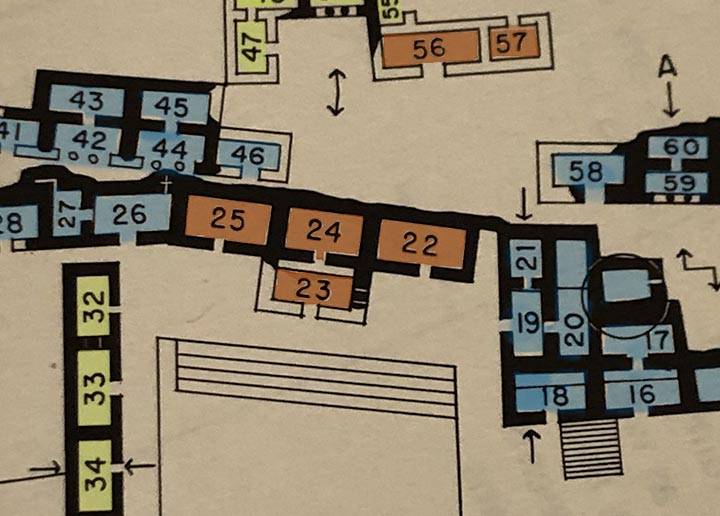
Legend: 1st Building Episode = yellow-green; 2nd Building Episode = orange; 3rd Building Episode = blue
In the site center, architectural style, form, layout, and iconography were important sources for inferring chronological and functional information. Excavations that exposed the building sequence of structures forming the architectural core of the ancient community revealed several stages of development.
The final layout of the urban core of Labna was the result of architectural programs conducted by several generations of rulers. The notion of sequential architectural programs and the identification of a particular form of built space as throne rooms provided a way to define temporal periods.
The notion that throne rooms were manufactured in a sequential order in palace complexes, when combined with analysis of architectural styles, suggest three major building episodes, each probably related to a ruler."
Manuel Tomás Gallareta Negrón, The Social Organization of Labna, a Classic Maya Community in the Puuc Region of Yucatan, Mexico, Ph.D. Dissertation, Tulane University, 2013, Abstract
Central Patio layout
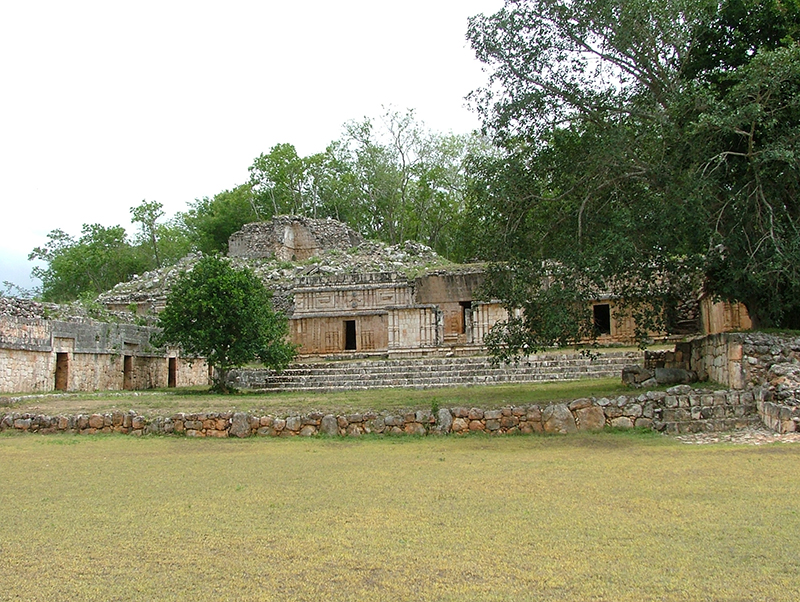
View of the Central Patio with oldest building on the left, Throne Room in center. This photo perfectly aligns with the color-coded map of construction phases. The oldest building is on the left, the throne room with it's out-jutting antiroom is centered above the low staircase while the last constructed structure stand in ruins above the throne room.
Wide stairs to throne room
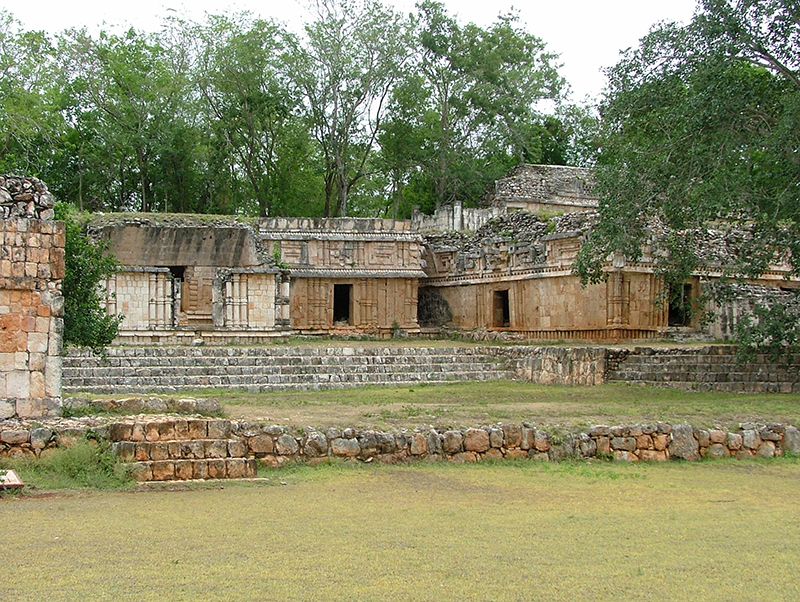
Three steps lead up to the central patio, while a wider stair leads to the throne room.
Early Throne Room in local style
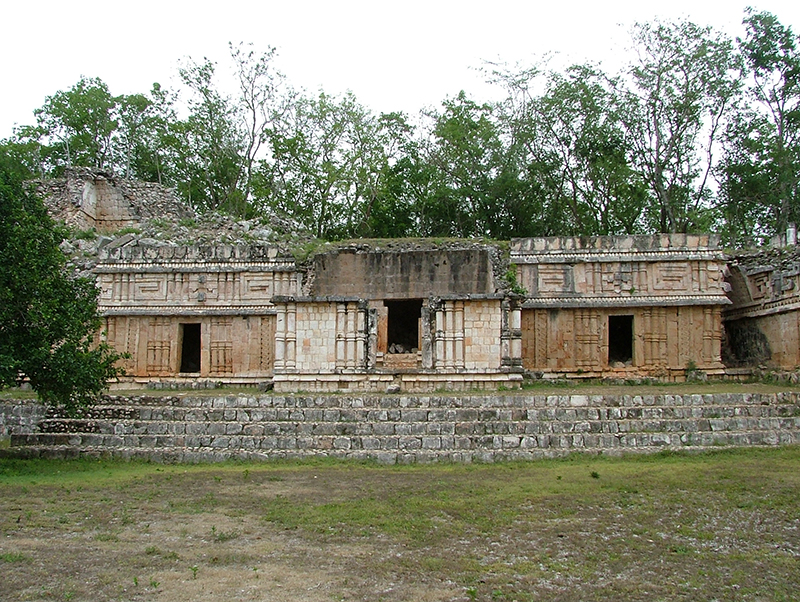
This throne room has a more local style, with abbreviated nosed masks and frets on the entablature, and frets combined with steps in the inner wall or front wall of Room 24.
Masks centered above doors
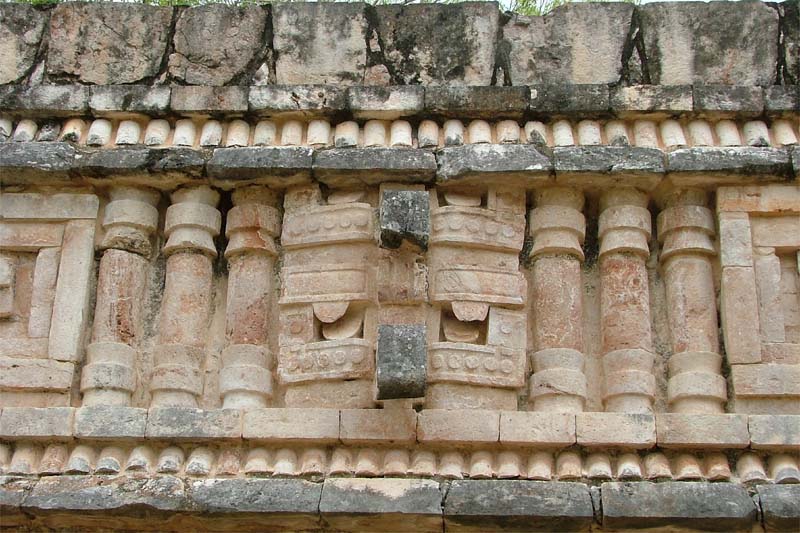
Masks are centered above the doors in the rooms adjacent to the early throne room. Spinden cites these masks as an example of extreme elimination of elements so that only the eyes and nose are left. He writes:
Space considerations have something to do with elimination in many instances. The lateral ear ornaments are the most elastic features of the mask panel...If the space is very short, the lateral ornaments are left off entirely. Since the first consideration in placing a mask was to get it centered over the door, this elasticity counted."
Herbert J. Spinden, A Study of Maya Art: Its Subject Matter & Historical Development, p. 122-3
Throne Room Symbols of Royalty
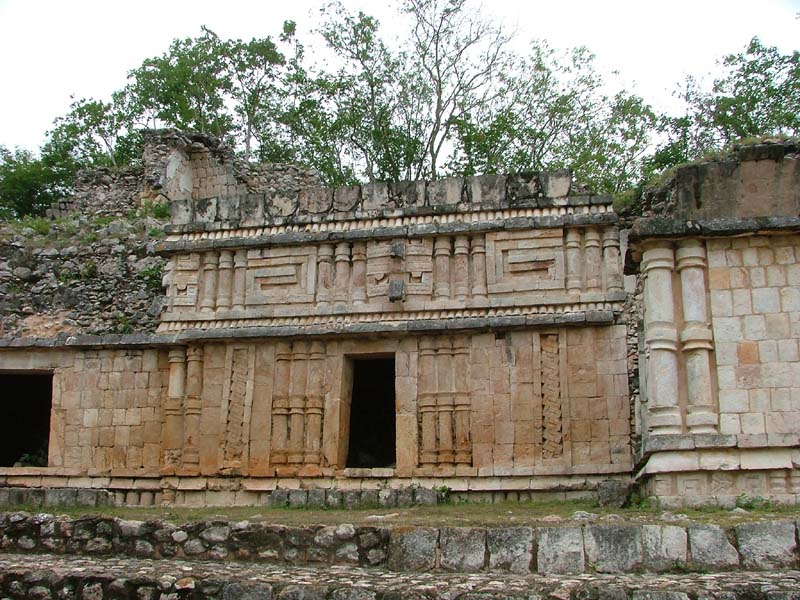
This is an interesting instance where the mask did not get correctly centered over a doorway. The lower part of the building surrounding the door is not symmetrical as the space between the columns and the vertical decoration is unequal, making it impossible to correctly center the mask.
The form and height of floor on the inner Room 24, the decoration in the internal wall of Room 23, and the anthropomorphic heads inserted in the lower molding, all indicate that this structure could function as a seat of power, a throne room with an antechamber, the heads representing the local founders or ancestors of the ruler that built it.
Head carved in foundation
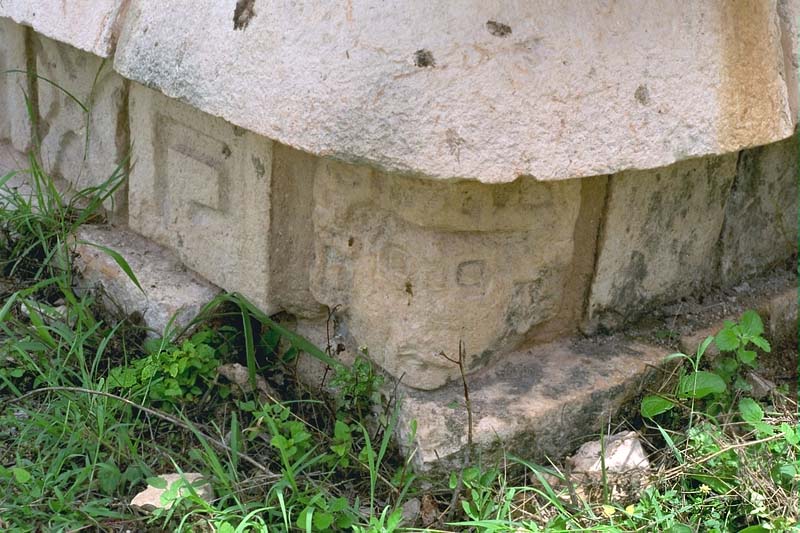
This ancestor figure is carved in a foundation stone of the palace at the base of the right corner of the out-jutting antichamber of the throne room.
More carved heads
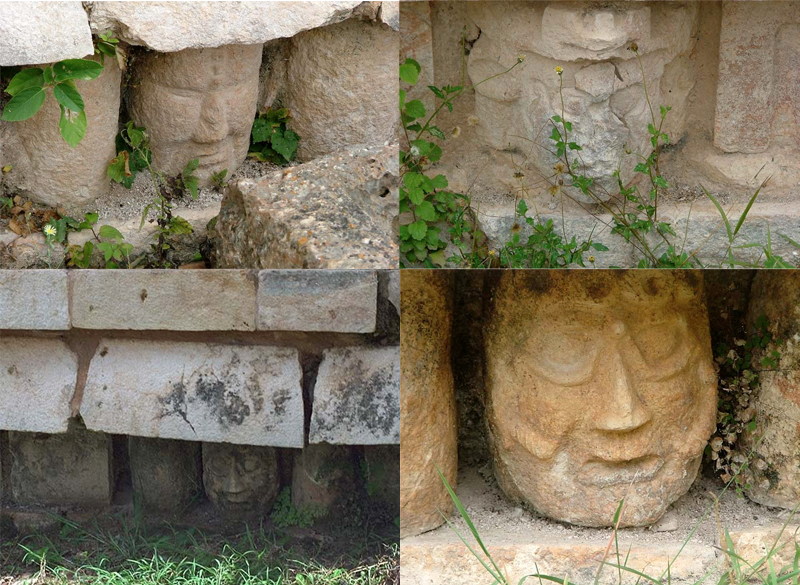
Carved heads line the entire foundation of the throne room. These are a few examples.
Throne room back wall
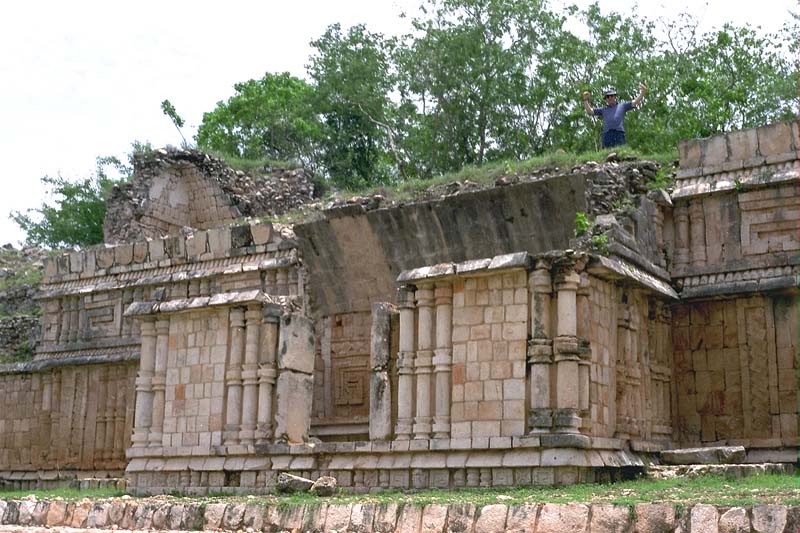
Through the throne room door we glimpse the decorated back wall. A Fret/Volute/Greek Key design can partially be seen on the wall of the throne room through the door of its antichamber, where only the left portion of a volute is visable. A similar pattern is evident on the cornices of Room 22 and 25 which frame the throne room, which can be seen on the right and left sides of the photo.
The long vertical framed mat pattern on the walls of rooms 22 & 25 is another power symbol related to rulership and royalty. This mat design can be seen on the right side of this photo.
Abstracted mythological symbol
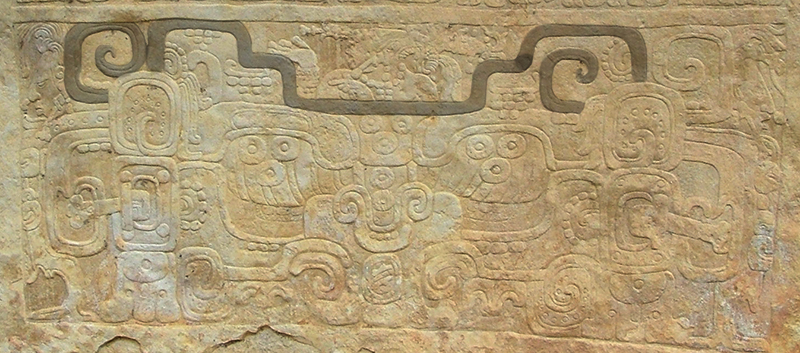
A bit of Maya mythology can further clarify the iconography of palace throne rooms. This is a representation of Yaxal Witz, the First True Mountain of Creation. The Witz mountain monster can be seen under the band, and is recognized by his snout and large eye–lashed eyes marked by circles representing stalactites.
When Mayanists talk about the cleft in the mountain of creation, they are referring to the darkened line which marks an indentation in the forehead of the monster — and can also represent a valley or depression in the mountain. From the cleft in the mountain's forehead the young corn god emerges at the moment of creation. Humankind arose in similar fashion.
Linda Schele has written that this abstracted double-stepped cleft ending in volutes represents the creation mountain cleft in its most reduced form. It is a very common pattern of decoration on Puuc style buildings and served to locate the building within Maya sacred geography and to relate the institution of kingship to the origin of the Maya world.
The V-shaped cleft of Yaxal Witz
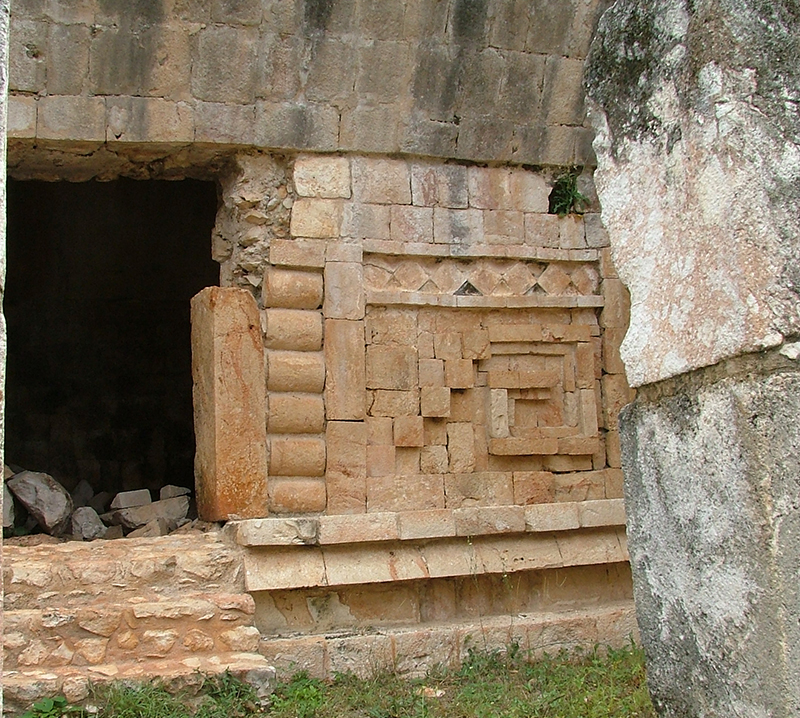
A large volute frames each side of the entrance to the throne room, while the central doorway represents the cleft in the mountain of creation.
The Ruler in the Mountain of Creation
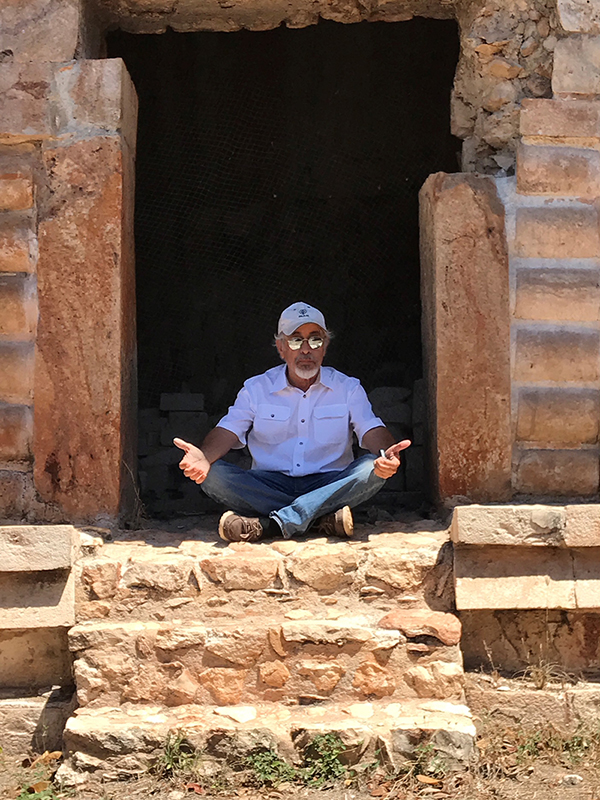
Photo courtesy of Kris Lamb. Thanks, Kris!
A ruler seated in the doorway of the throne room forms a composition with the volutes surrounding the door, suggesting that he is emerging from the mountain cleft just as the Hero Twins did at the beginning of time. Archaeologist Tomás Gallareta sits in the elevated inner doorway of the old throne room, much as an ancient Maya ruler might have done.
Palace constructed over centuries
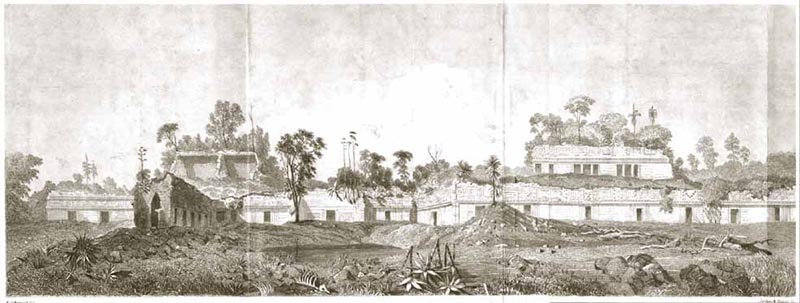
The Palace is truly a gigantic sprawling building contructed over centuries. Looking back at the sprawling Palace during their 1841 journey to Labna, Stephens writes:
Still further in the same direction, going through the woods, we reach the grand, and, without extravagance, the really magnificent building represented in the frontispiece to this volume. It stands on a gigantic terrace, four hundred feet long and one hundred and fifty feet deep.
Stephens & Catherwood, Incidents of Travel in the Yucatan, vol. 2, p. 34
Palace is a walk through time
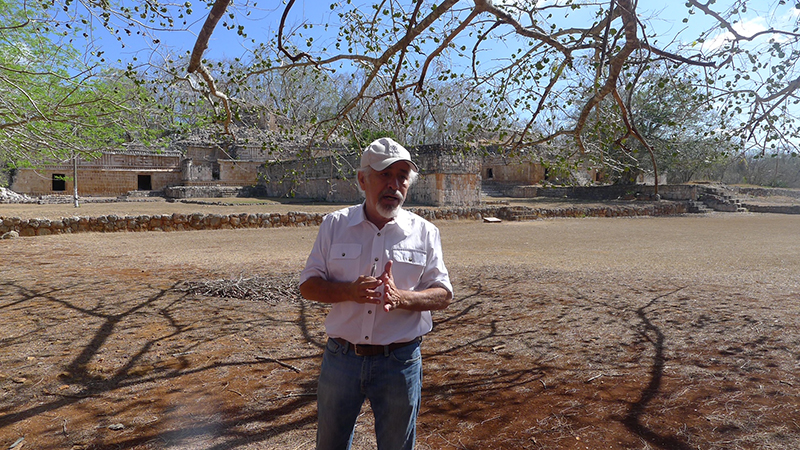
Photo courtesy of Kris Lamb. Thanks, Kris!
The Palace became such a huge and sprawling building by growing wings and extensions and stories and modifications as it unfolded over time. A walk through the palace is a temporal journey through Late and Terminal Classic building phases where changes and styles and expansions come into focus. Archaeologists have identified three major building phases at the Palace.
Sacbé lead to current throne room
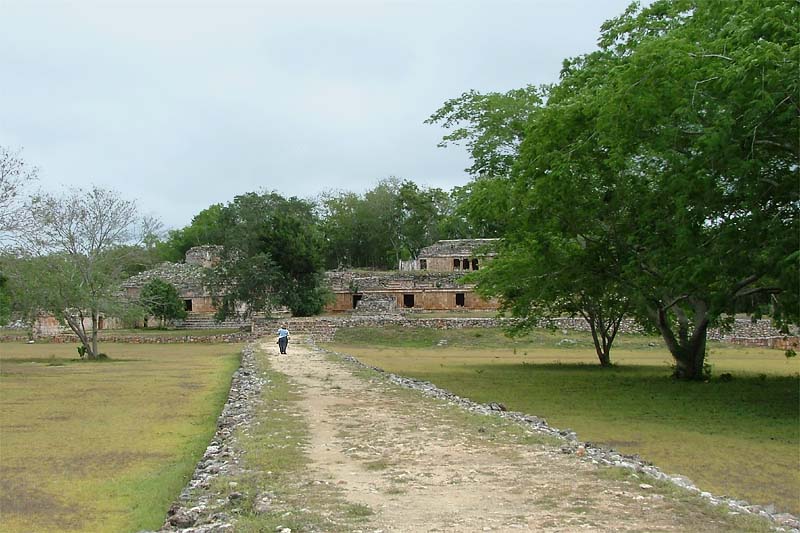
Archaeologists discovered that the direction of the Sacbé was modified in a final building stage. Originally the Sacbé had pointed directly toward the old throne room in the Central Patio of the Palace (toward the wide stairway to the left its current path), but a later modification moved it to the east to point directly at the new Throne Room 19 in the East Wing, as shown in this photo.