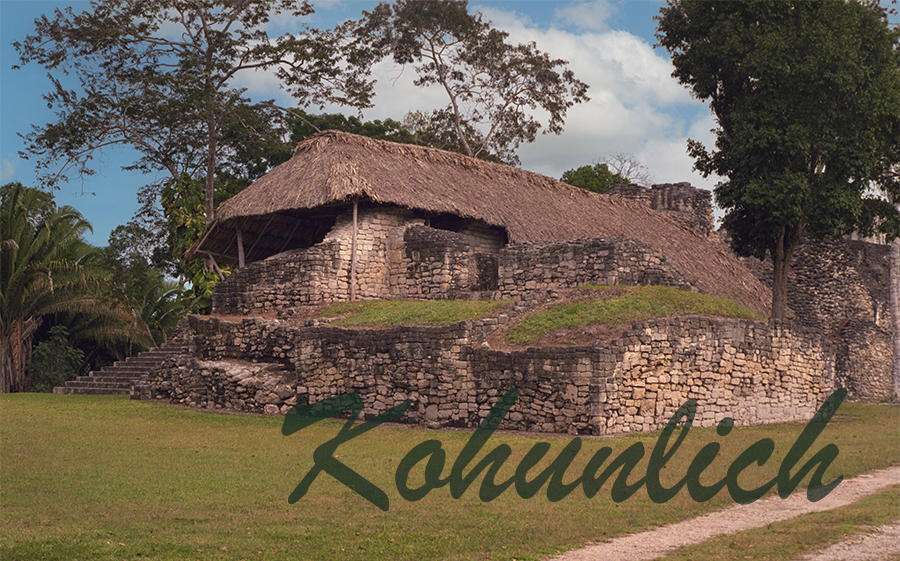
Click here for a short Kohunlich reading list
The site of Kohunlich is best known for its stunning Temple of the Masks, an Early Classic pyramid whose central stairway is flanked by huge humanized stucco masks. Built around 500 A.D., this is one of the oldest constructions at the site.
After 700 A.D., this temple was covered over with a Terminal Classic construction, which protected the masks and accounts for the marvelous state of their preservation today. The only standing remains of the later temple are some steps in the lower portion of the stair.
The Temple of the Masks
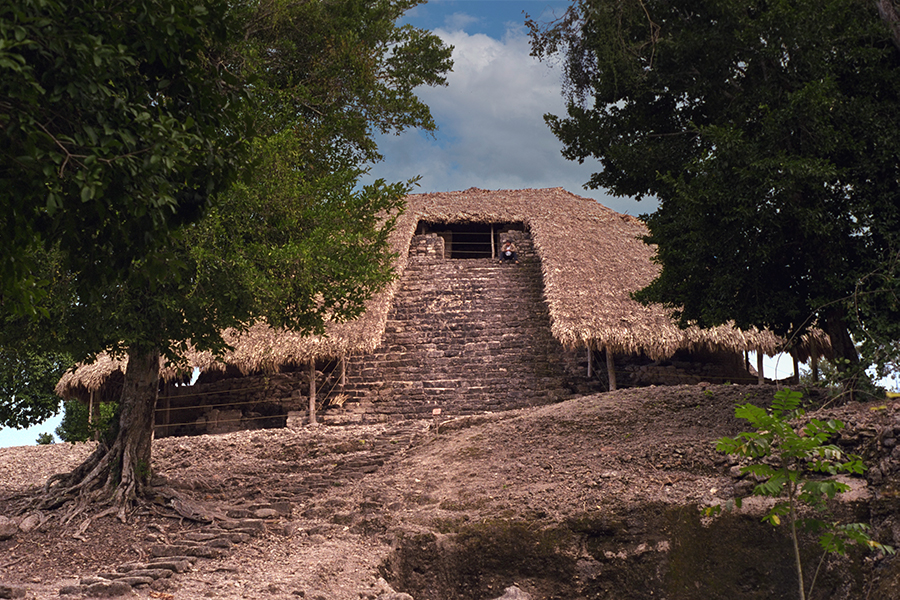
Note the guard sitting at the top of the staircase on the right.
The masks, hidden under a thatch protection, adorn both sides of the stairway.
In 1969 looters reportedly discovered the site, removed some of the outer covering of Structure I, and revealed the masks. Ignacio Ek, of the nearby village of Francisco Villa, came across this work and reported it to authorities, who then took steps to protect the masks and the site, which was known locally by the name Kohunlich at that time.
The site was first visited by archaeologist Victor Segovia in 1968, but it was not until 1969 when looters uncovered the masks that the site gained attention.
Joyce Kelly, An Archaeological Guide to Mexico's Yucatan Peninsula, p. 291
Masks to the right of the stairway
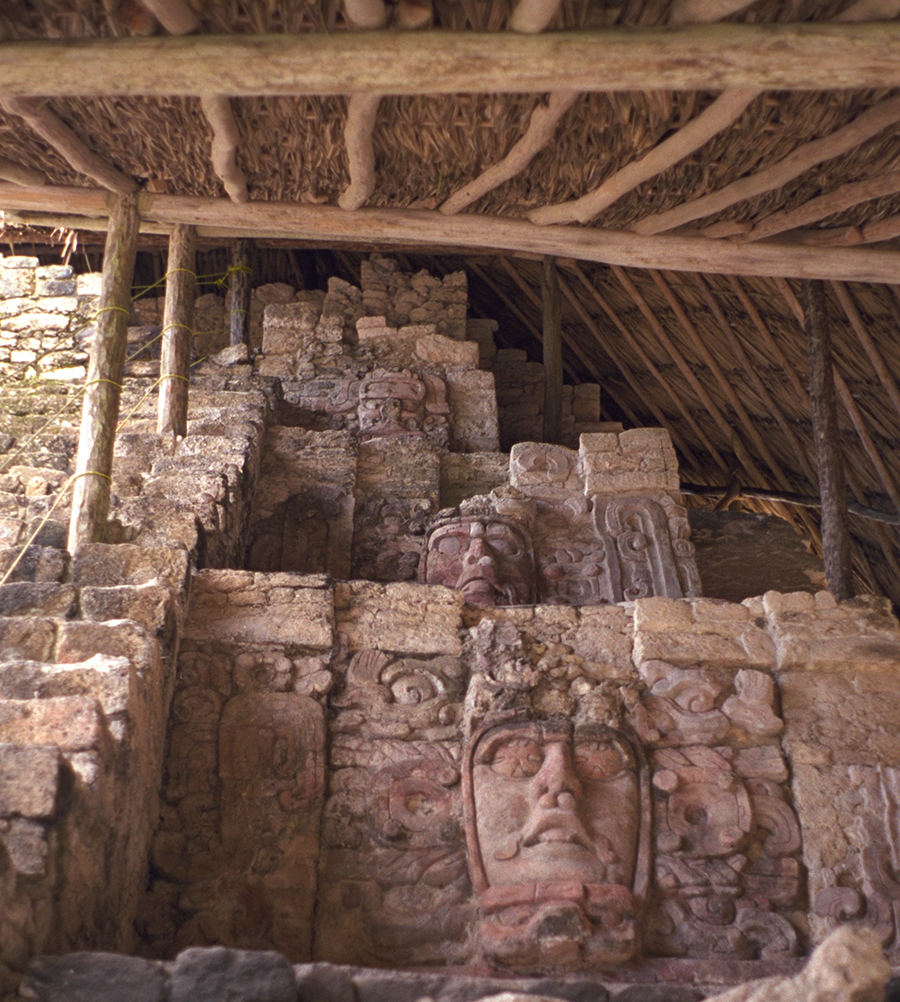
A dramatic column of masks ascends the south side, to the right of the stairway.
The masks that serve as ornaments look towards the sunset and represent the members of the ruling lineage of Kohunlich, all gathered beneath the form of Kinich Ahau, Face of the Sun, one of the most important Mayan dieties.
INAH sign in front of Pyramid of the Masks
Bottom Mask
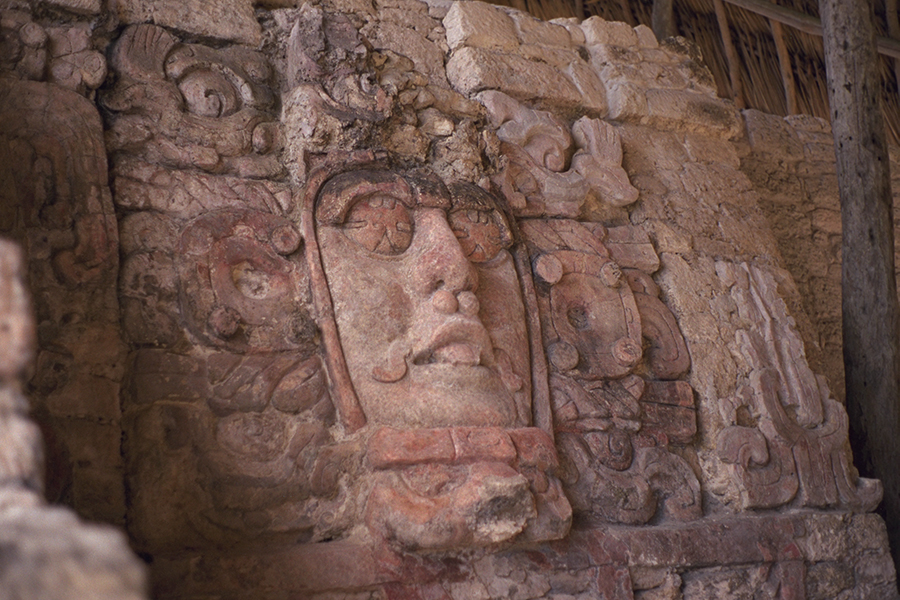
Closeup of the beautiful sun-marked mask at the bottom right of the stairs.
The markings in the eyes are most probably the Mayan hieroglyphic sign "kin", meaning sun/day. The sign itself is a cosmogram, which basically is a map of the directions (the four-leafed look to the symbol is actually marking the four cardinal directions and the center). This sign would make sense on such stucco masks, which depict sun deities.
Information courtesy of Dave Hixson, Tulane University
Middle Mask
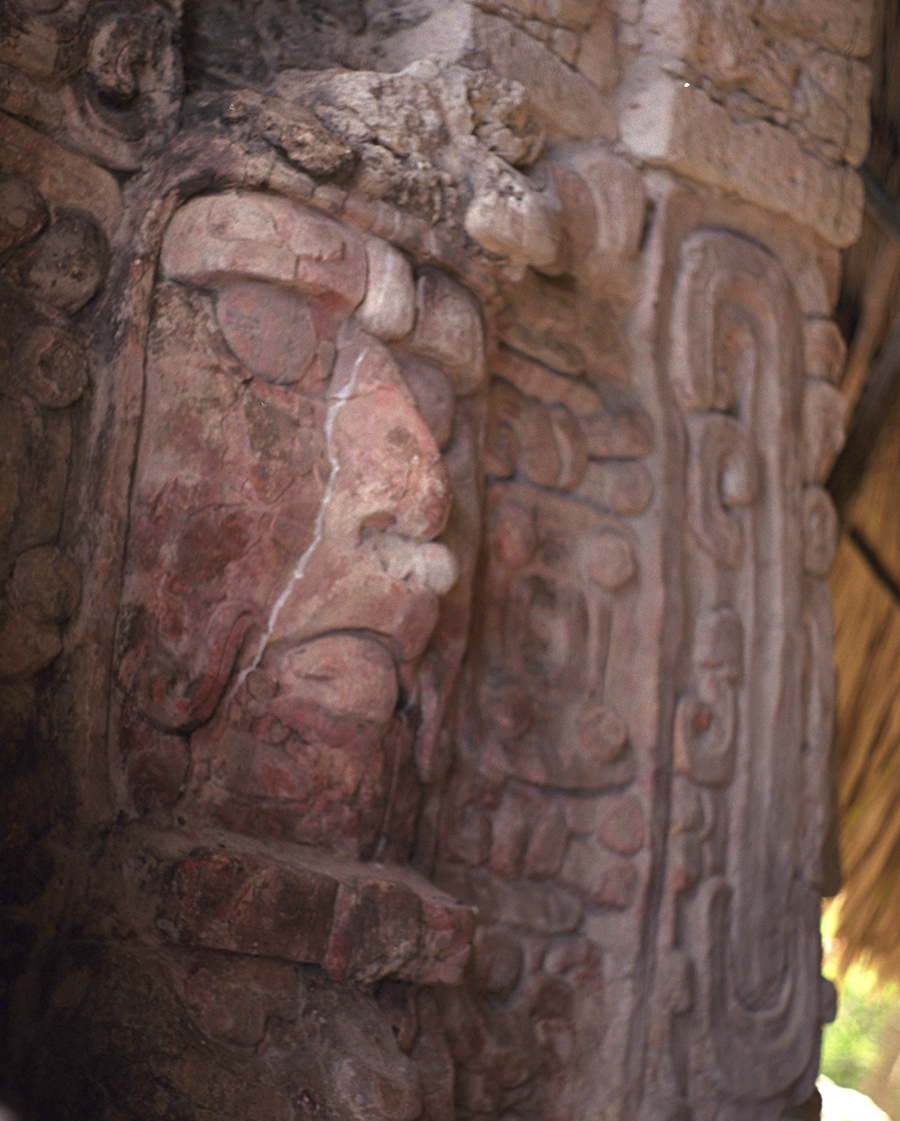
The middle mask to the right of the stairs has speech scrolls & breath ornaments. The round ornament under the nose is said to represent vital breath in Maya iconography. One side of the ornament has chipped away, but originally it was part of a pair of breath elements. Likewise, the scrolls emerging from the sides of the mouth also represent breath or, in some cases, speech or song scrolls.
The topmask Mask
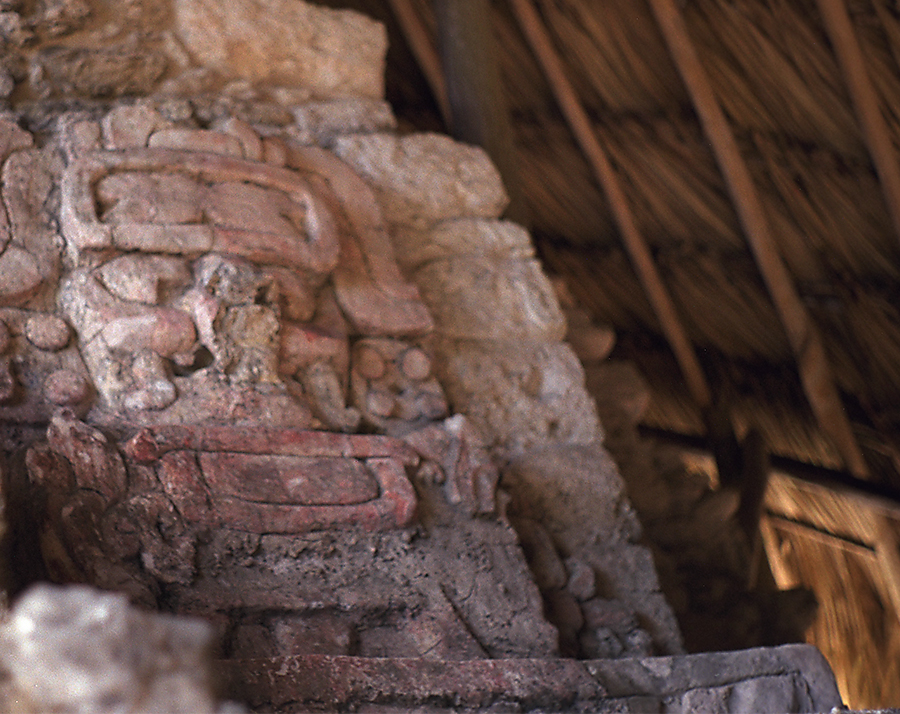
While the bottom and middle pairs of masks are realistic and humanized, the top most masks are smaller and quite stylized. The topmask is, unfortunately, in poor condition and has completely lost its nose.
Masks to the left of the stairway
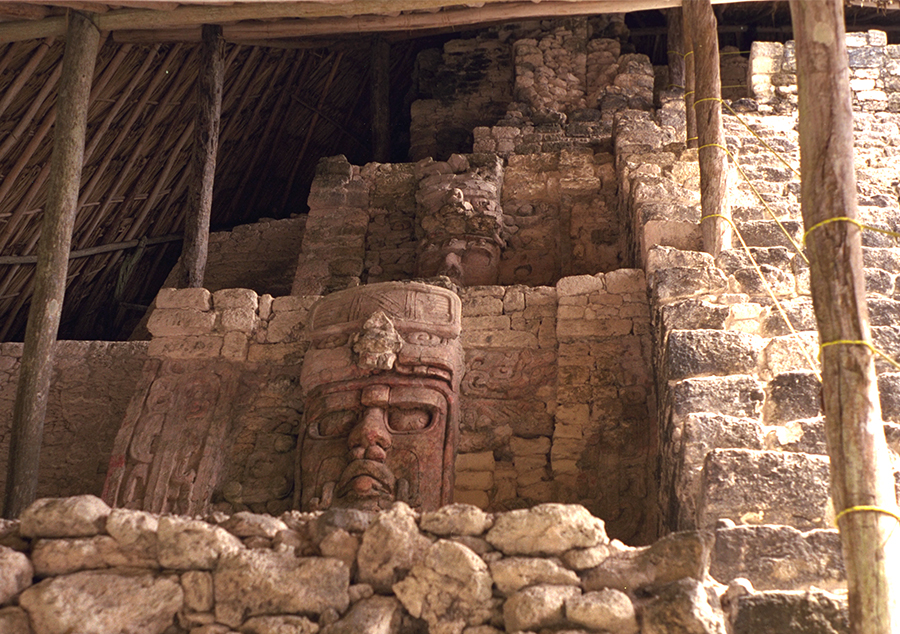
Powerful masks of the sun god, Kinich Ahau, also flank the stairway on the left.
Although Kinich Ahau, or Ah Kinchil, the sun-faced one, has been considered a distinct figure, he seems clearly to have been the day aspect of Itzamna.
As such, symbolizing the sun's life in its daily journey across the sky, and hence all life, this aspect of Itzamna was closely associated with Maya rulers.
The rulers of several Maya centers appear to have assumed an identity with Kinich Ahau, either because they wanted to associate themselves with their powerful supernatural patron or because they wanted to foster the belief that they were manifestations of the sun god.
Robert Sharer, The Ancient Maya, p. 531
Kinich Ahau mask, bottom left
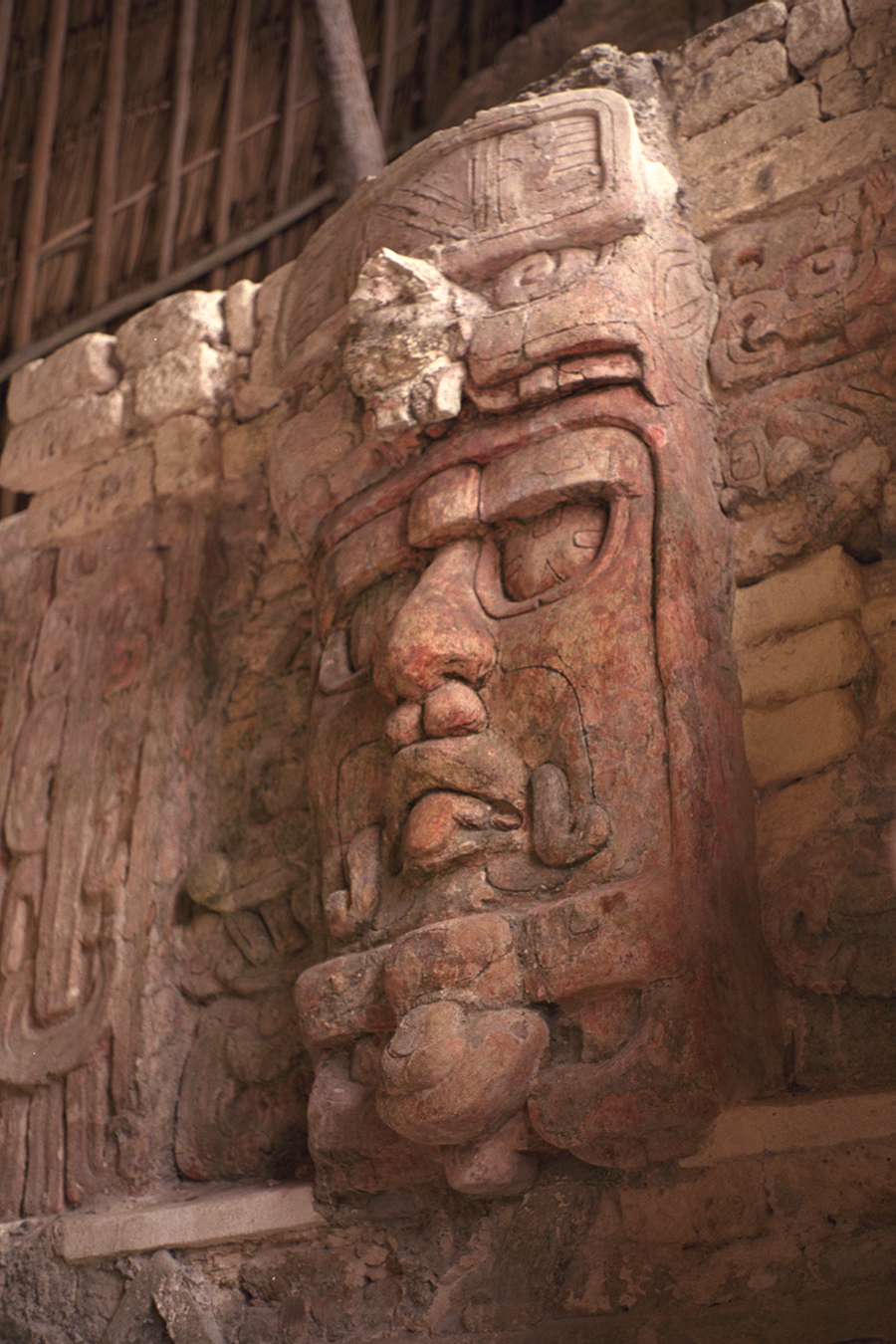
Kinich Ahau displays speech/breath/life force symbols at mouth & nostril.
This powerful rendition of Kinich Ahau is over six feet high and is carved in stucco over a stone base. The bird mask which acts as a headdress for the god is plainly visible, but the jaguar mask under the god's chin which marks him as a sun jaguar is more difficult to make out.
Jaguar Sun or Sun at Night
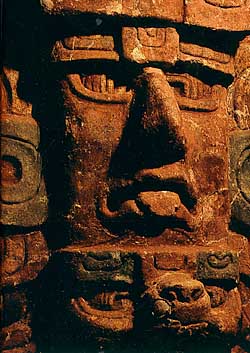
The jaguar mask signifying a Jaguar Sun or Sun at Night is plainly visible in this image from Copan even though it is somewhat difficult to see it under the chin of the sun god at Kohunlich. This photo is from the Yehnal temple at Copan, and is a portrayal of the founder of the Copan dynasty in the guise of sun god.
The sun god in association with jaguar elements tells us that these images represent the jaguar sun or the sun at night, a powerful supernatural image among the Classic Maya. The ancient Maya believed that each night the sun plunges beneath the earth to began its nightly journey through the underworld. It is interesting that the temple of the masks at Kohunlich faces the setting sun.
The Cohune Palm
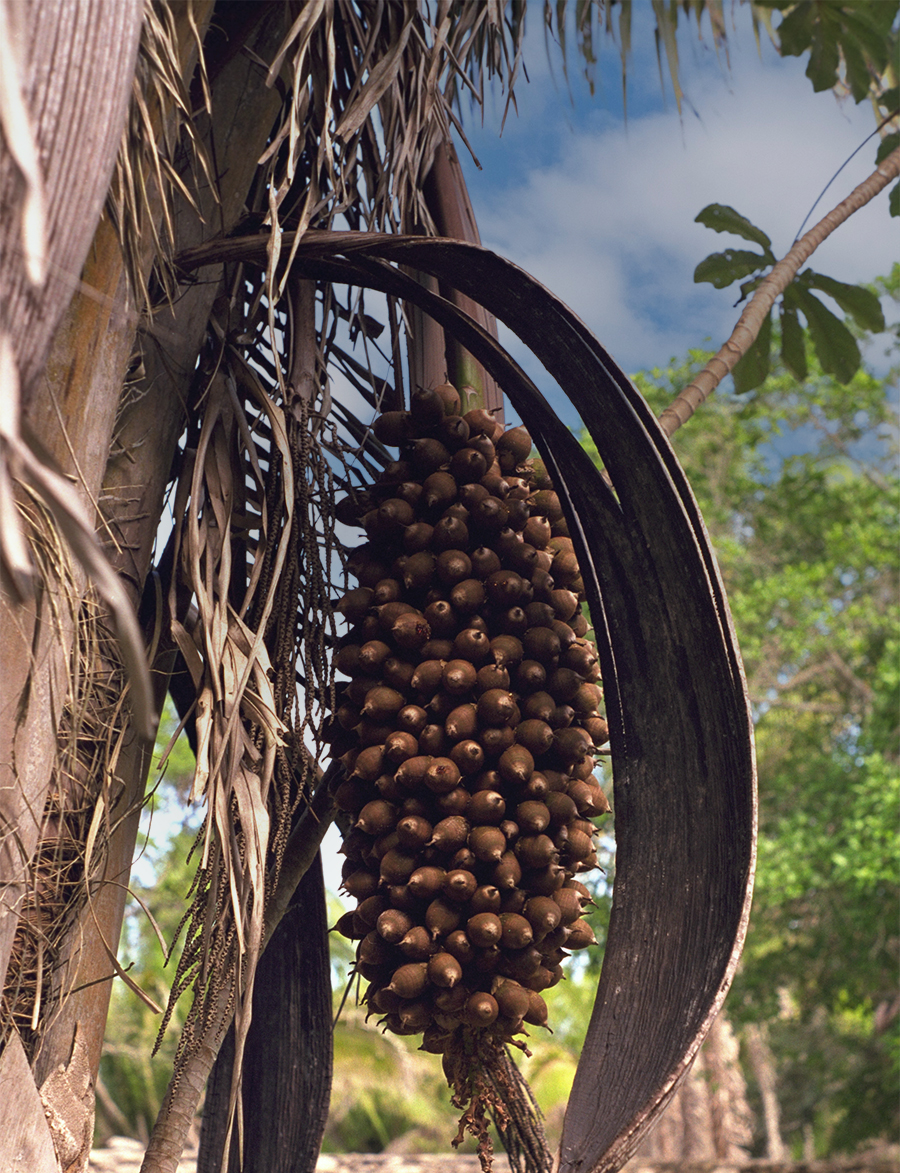
The modern name of Kohunlich derives from the Cohune Palm, which the Maya used for its edible oil. The ancient name of the site is not known.
View of Kohunlich palms
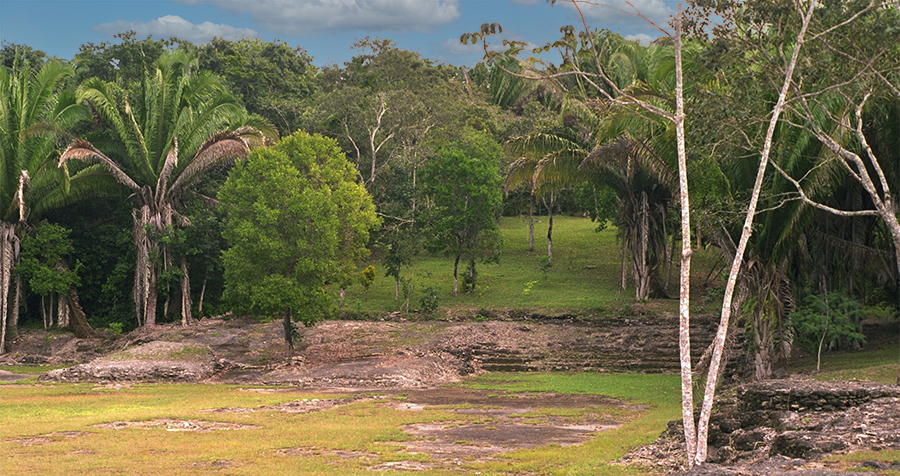
A parting view of Kohunlich showing its plethora of Cohune Palms