Rosalila temple
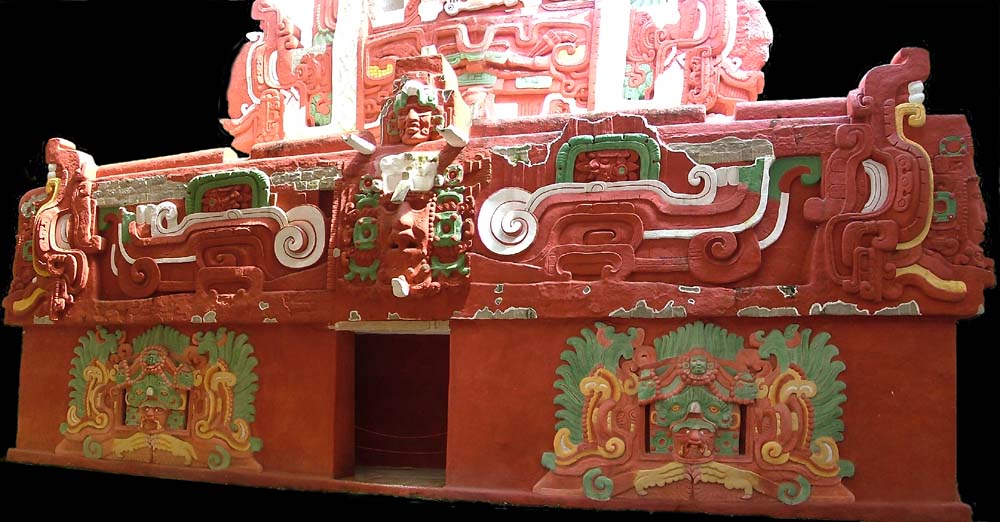
The archaeologist Ricardo Agurcia, tunneling beneath Temple 16 in the East Acropolis, discovered an intact large temple which he called Rosalila. Agurcia's YouTube lecture, Temples that Speak: Art and Architecture at Copán, Honduras, offers a fascinating glimpse into his discovery of Rosalila and is "must watch" viewing (the sound gets better as the video progresses).
The structure was still coated with its heavy stucco decoration and, beneath a final wash of white, brilliantly coloured in red, green and yellow. Its complex iconography sets Yax K'uk'Mo' into a grand cosmic scheme, fusing him with the giant sky deity as a diving bird within a layered programmed that includes a mountain of sustenance, as well as skeletal and crocodilian imagery...Rosalila was the last building at Copan to use stuccowork on such a lavish scale. With deforestation of the valley now well advanced, the great quantities of firewood needed to reduce limestone to plaster could no longer be afforded and all of it successors show a move to stone-carved decoration.
Simon Martin & Nikolai Grube, Chronical of the Maya Kings and Queens, p. 198
The Temple that Spoke
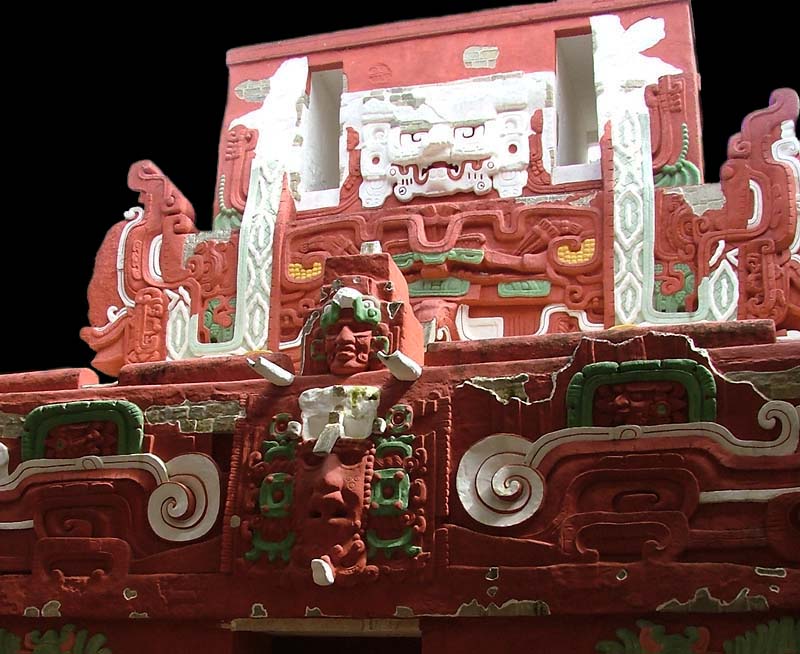
Agurcia believes the white upper passageways served as natural wind instruments and that the temple "spoke" when the winds blew. Simon Martin and Nikolai Grube have a slightly different interpretation:
Rosalila's interior was blackened by well over a centry of smoke and incense—rituals appropriate to its role at the heart of ancestral veneration—and vents in its façade were designed so that billowing clouds would interact with the sculpture in an animated tableau.
Simon Martin & Nikolai Grube, Chronical of the Maya Kings and Queens, p. 198
Rosalila was obviously an especially venerated building, for not only was it maintained and used for an exceptionally long time, but when it was finally abandoned it was carefully preserved and buried intact, unlike most Copán buildings, which were at least partially demolished before being covered by new construction.
Robert Sharer, The Ancient Maya, p. 313
Ground mica made Rosalila glitter
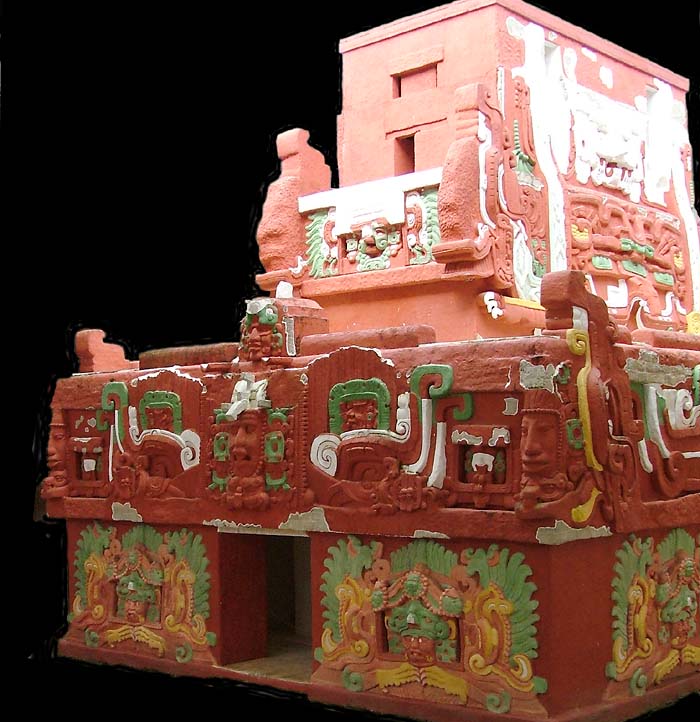
Rosemary Goodall, a Brisbane physical and chemical sciences PhD student, used infrared analysis technique, FTIR-ATR spectral imaging, to analyze the painted surfaces of the stucco masks that adorn the corners of the Rosalila temple, built in about AD 550. Mrs. Goodall found that the Mayans mixed finely ground muscovite mica in their paint, which would have made parts of the building glitter in the sun.
The Australian: Higher Education, Jill Rowbotham, January 23, 2008.
Inside the buried rooms of Rosalila, Agurcia's excavations found several termination caches, the most spectacular being a horde of nine beautifully worked eccentric flints." [use your browser's BACK button to return here]. In a Penn Museum video titled Eccentrics, Dr. Payson Sheets, who actually teaches classes in flint knapping, speaks about the making of eccentrics and Agurcia's discovery of the cache at Rosalila, complete with Agurcia's photos of the actual discovery of the cache.
Robert Sharer, The Ancient Maya, p. 313