Stela 2
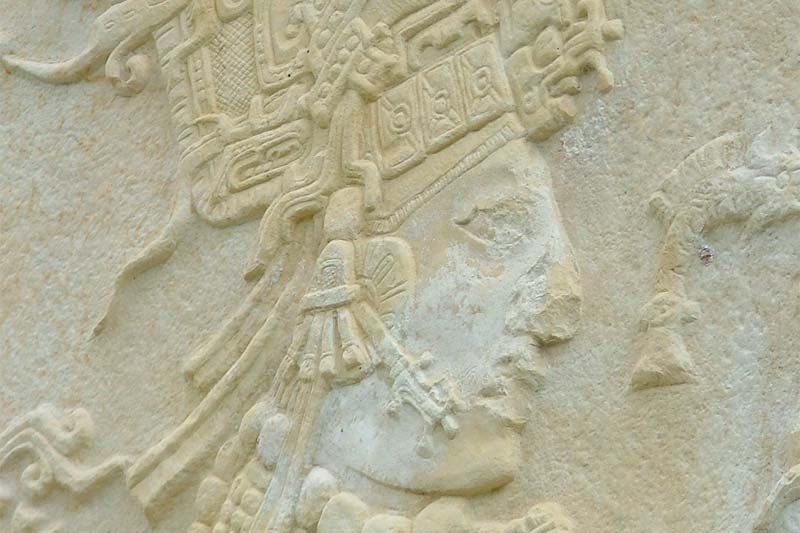
Stela 2 portrays the ruler of Bonampak, Chaan Maun II, as he prepairs for the ritual presentation of his royal heir to the assembled court, presumably the same event illustrated in Room 1 of the House of the Murals.
Chaan Maun reigned from 776 to 795 AD. The events portrayed in Bonampak's stelae and murals took place in 790–792, possibly under the auspices of the neighboring city-state of Yaxchilan.
Chaan Muan's wild elaborate headdress
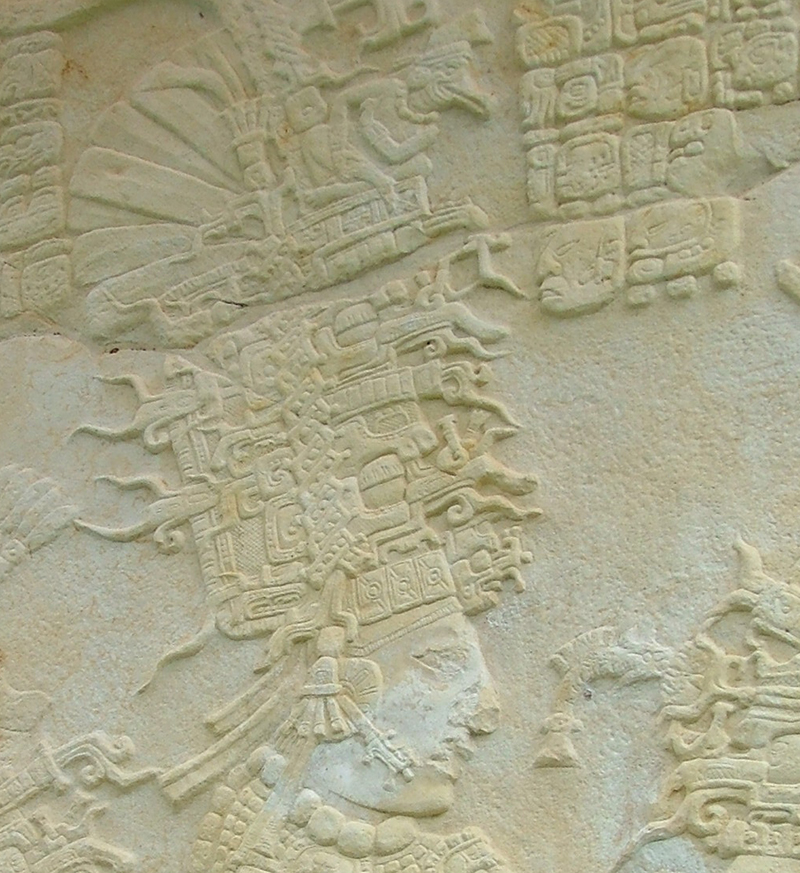
David Stuart, who argues that the Maya placename for Bonampak was Vulture Hill or Usij Witz (named for the hill upon which the Acropolis rises), writes:
The main headdress symbols are clear to see, however, including two stacked witz heads, easily identifiable by their profiles and large eyelashes.
Above the uppermost mountain head we find a haughty vulture, dressed as a lord and seated human–like atop a sky band.
I interpret the king’s headdress as a symbolic array incorporating hieroglyphic elements, like many others known from the Mesoamerican world. Here, on a monument erected on the main steps leading up the mountain, Yajaw Chan Muwahn seems to assume the identity of Vulture Hill itself.
David Stuart, Vulture Hill: The Place Name of Bonampak, University of Texas at Austin, December 2006
Note: This type of headdress was probably lightweight and made of wood, textiles and paper.
Chaan Muan with mother & sister
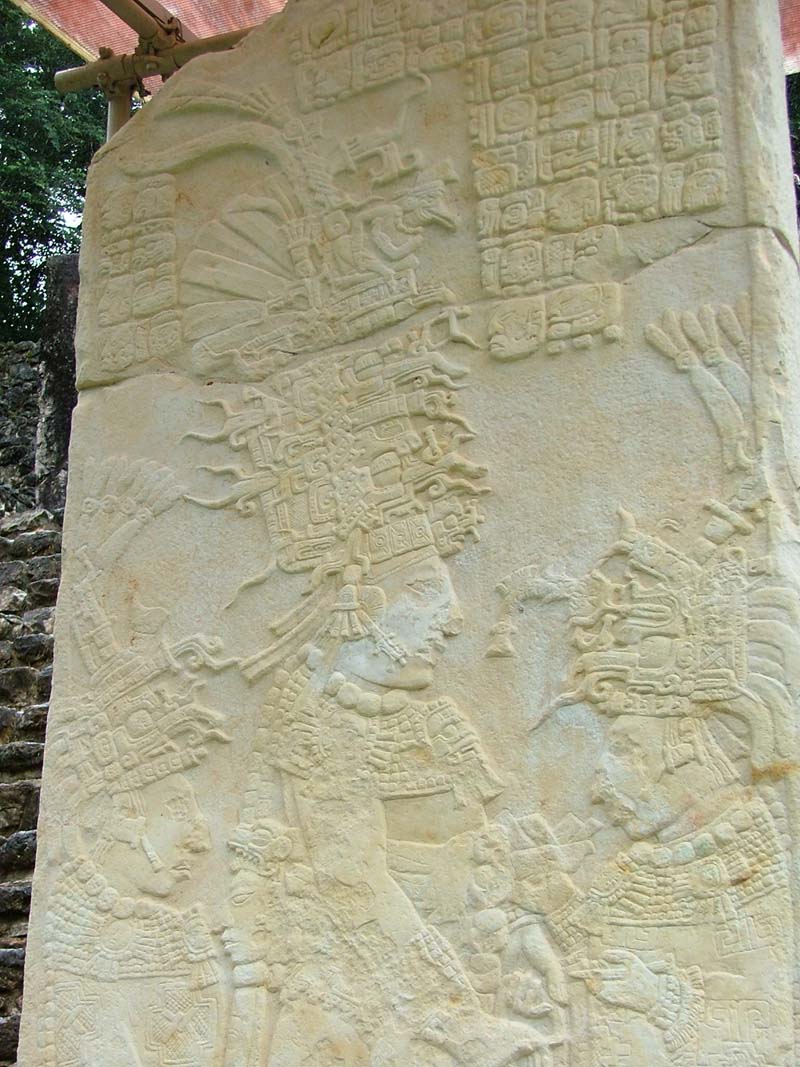
This stela portrays Chaan Maun preparing for a ritual sacrifice done to communicate with deceased ancestors in preparation for the presentation of his heir to the assembled court. He is assisted by his mother [on the right] and his wife, the sister of Shield Jaguar III of Yaxchilan. His mother is handing him a sting-ray spine and a bowl of paper strips.
A particularly important title of classic nobility was "People of the Waterlily". It is used here as an element in Chaan Muan's mother's headress. Follow Chaan Maun's gaze as he appears to look at it directly. In addition, there is a fish nibbling the waterlily, which symbolized fertility and the bounty of the earth to the Maya.
Note: the eyes of all three protagonists had been defaced, probably in ancient times. This was done in order to ritually kill the power of the stela.
Exquisite textiles in clothing
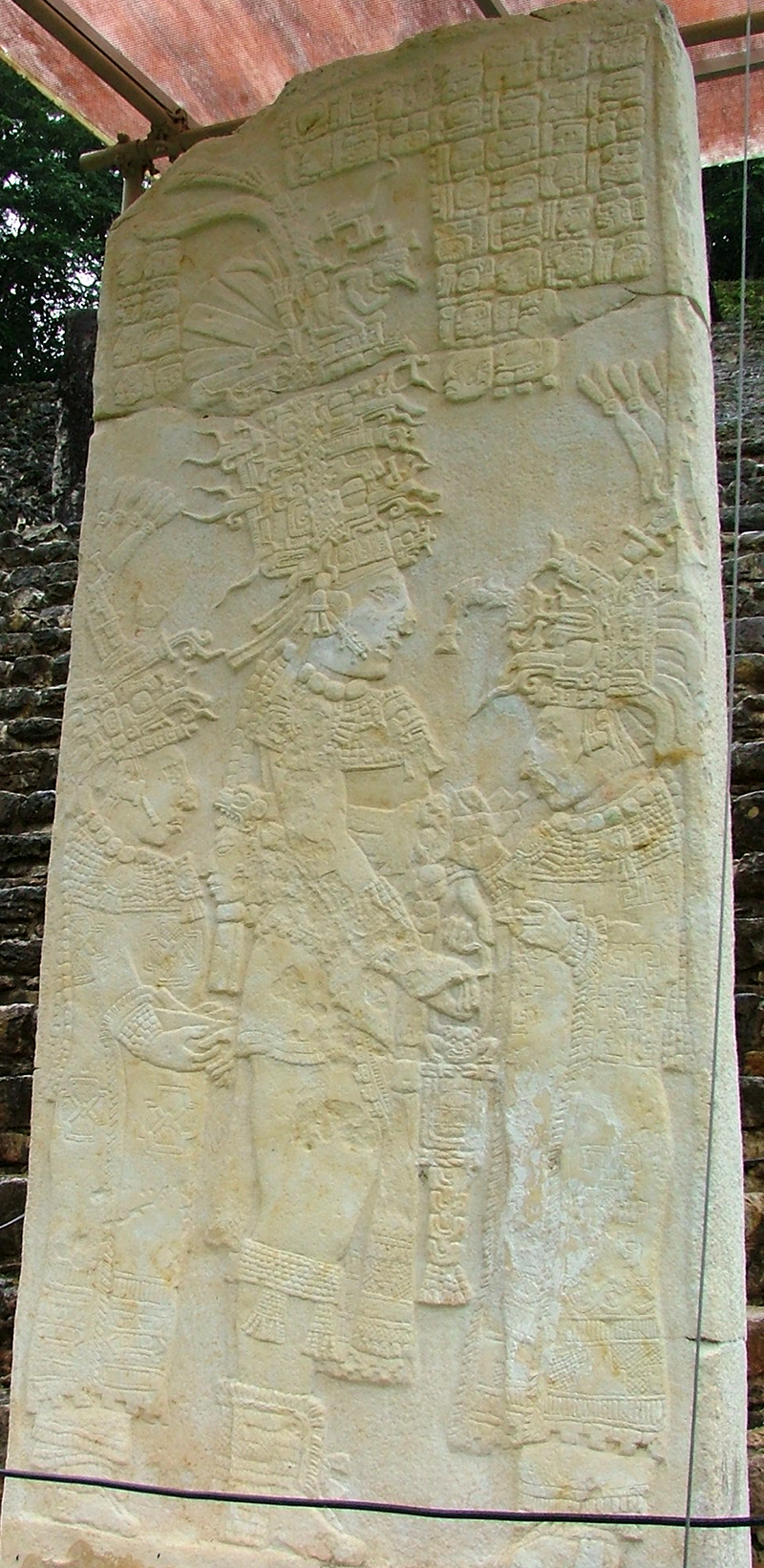
The designs [on the women's dresses] were probably brocaded rather than embroidered, for brocading (working the design while the weft is being inserted on the loom) is usual among present-day Maya weavers. The material was undoubtedly cotton. The long undergarment falls to the ankles; the overgarment reaches below the knees.
Ancient Maya Relief Sculpture: Rubbings by Merle Greene. The Museum of Primitive Art. New York, 1967
Details of beautiful woven fabric
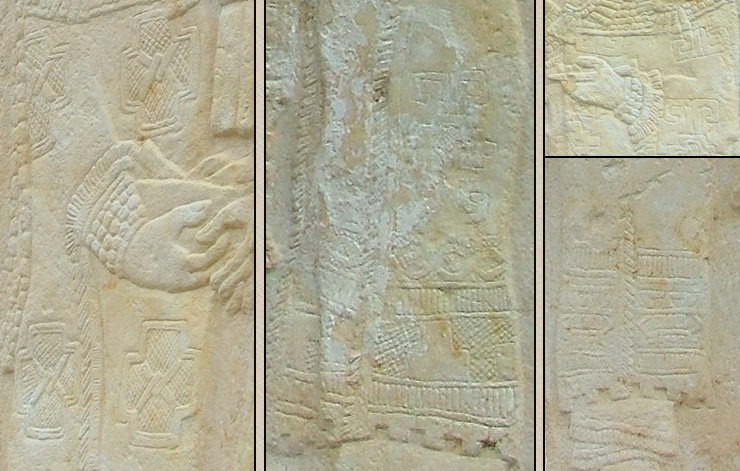
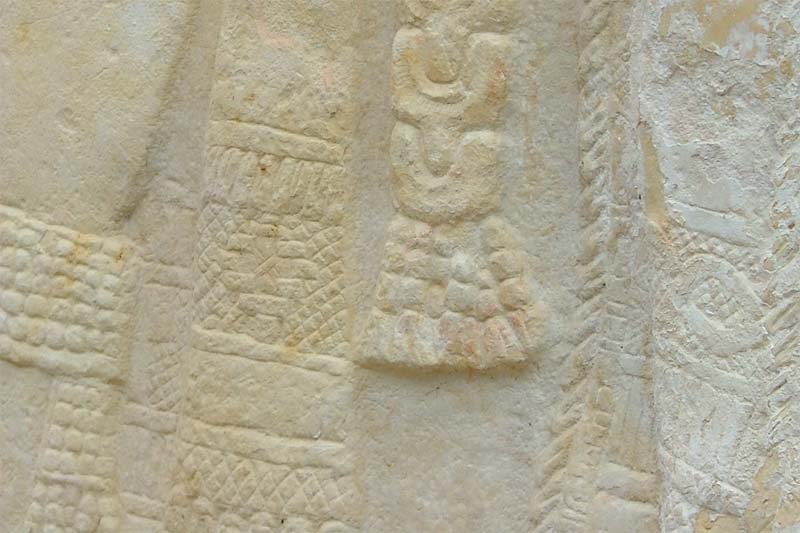
Woven textiles with complex and beautiful patterns are a tradition which the Maya continue today:
...across Chiapas and Guatemala today, the vibrant textile designs provide living texts that can sharpen our sense of the past as embedded in and revitalized by the present.
Kathleen Berrin, Courtly Art of the Ancient Maya, p. 14